
Architecture Exceptions Need an Exit Plan
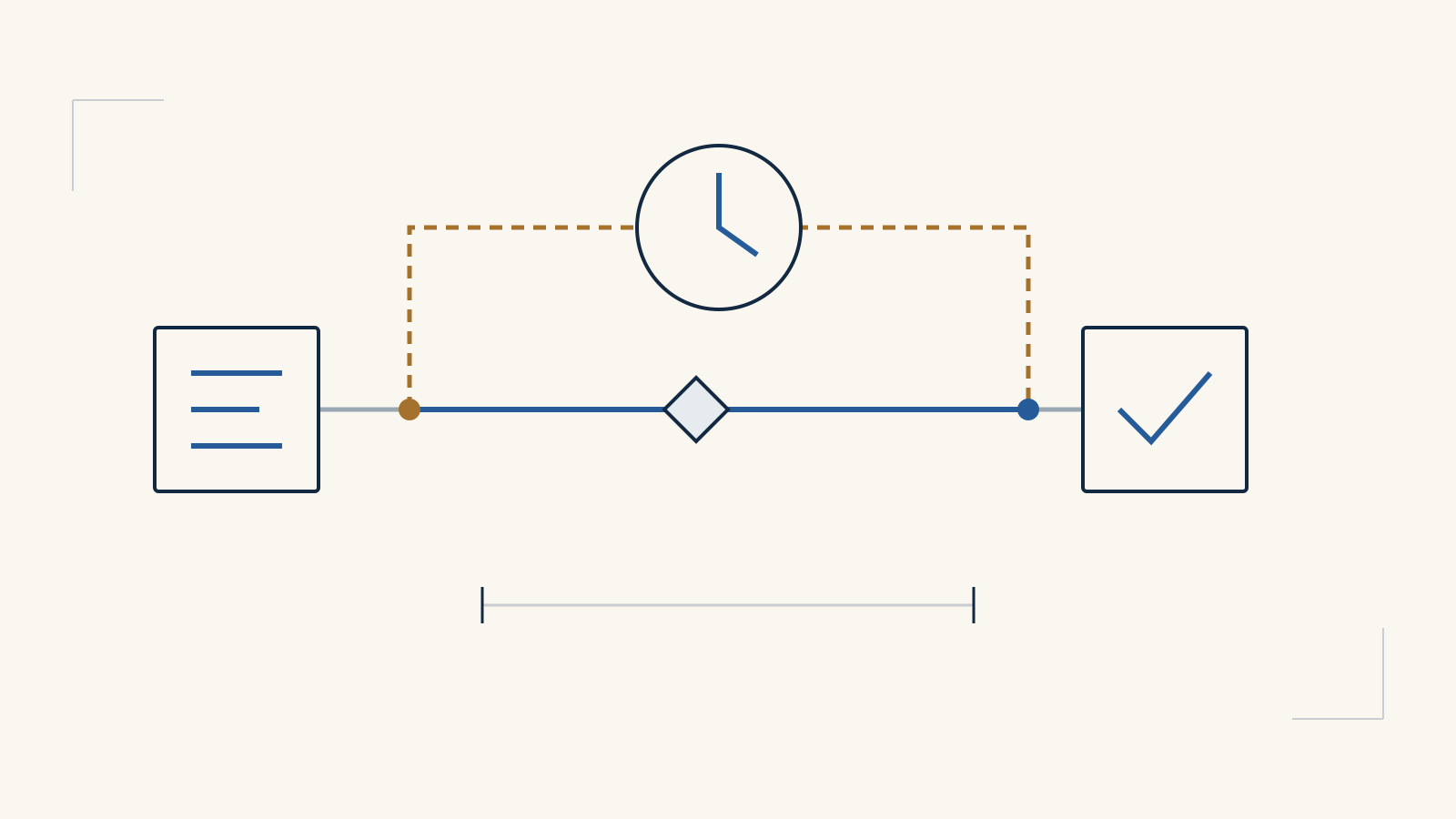
A practical architecture exception process: define the boundary, assign an owner, set a review date, and agree the evidence needed to close the exception.
On this page
An architecture exception needs more than permission to proceed. It needs a clear boundary, an accountable owner, a point at which permission must be reconsidered, and evidence that will show the temporary arrangement has ended.
Without an exit plan, “approved for now” can become the architecture by default. The team that accepted the trade-off moves on, the workaround keeps running, and a later project treats it as an established pattern.
This guide uses an illustrative reporting integration to show how to make a temporary exception reviewable throughout its life. It is a practical discussion guide; your organization's approval and release requirements still govern the work.
Start with the reason for the exception
Suppose an internal standard calls for automated reconciliation of reporting transfers. A replacement reporting service is ready for a limited rollout, but its automated reconciliation capability is not ready. The team proposes having an operations owner compare transfer totals manually for the initial rollout.
The first question is whether that temporary arrangement is acceptable at all. A delivery deadline explains why the team is asking. It does not establish that the proposed alternative provides adequate assurance.
Ask what the standard protects, how the temporary approach addresses that concern, and what uncertainty remains. In this example, the relevant owners need to assess whether a manual comparison can identify the discrepancies that matter, whether they can investigate them in time, and whether the necessary staff are available.
If those questions cannot be answered, the next step is investigation or a change in rollout scope. An exception form cannot supply missing evidence.
Keep the exception narrower than the standard
Describe exactly what the proposal would permit. For the reporting example, that might be one named transfer, a defined rollout group, and a specified reporting window. It should also say what is excluded: additional transfers and a wider rollout do not inherit the exception automatically.
Keep the original standard visible. Reviewers should be able to distinguish a temporary departure from a decision to revise the standard itself. If the standard no longer fits the intended operating model, address that through its normal review process.
A useful architecture exception process also makes approval authority explicit. AWS's guidance on architecture review boards recommends a defined exception process involving IT and business assessment and sign-off, with expiration dates rather than indefinite exceptions.
The appropriate participants depend on the consequence being accepted. In the example, architecture review alone should not stand in for the operations owner's agreement to perform the reconciliation work.
Agree the exit evidence before approving the start
“Automation complete” is too vague to close this exception. A feature may exist without addressing the reason for the original standard.
The team should agree what the replacement process must demonstrate. For this illustrative transfer, the evidence could include showing that the automated process identifies an incomplete transfer, routes a discrepancy to the responsible owner, and produces the information that owner needs to investigate it. The relevant reviewers must decide which cases and evidence are sufficient for their requirements.
Then connect that evidence to delivery work. Who implements the missing capability? Who checks it? Who confirms that the operating procedure has changed? An exit plan without assigned work is an intention rather than a route to closure.
Keep approval and execution responsibilities distinct. The person authorized to accept the temporary arrangement may not be the person who builds its replacement or performs the daily manual check.
Put review before expiry
An expiry date marks the limit of the current permission. A review date gives the team time to act before that limit arrives. Choose both deliberately, based on the work required to investigate, decide, and change course.
For the reporting rollout, the owner might arrange a review before the next planned expansion. The team can examine whether manual comparisons were performed, whether discrepancies occurred, and whether the replacement capability is ready. The dates should follow the actual operating needs; there is no universally appropriate exception duration.
Also identify events that require earlier review. A change in volume, a missing operations owner, or an unexpected discrepancy could undermine the basis of approval before the calendar date arrives. The architecture review checklist provides a way to identify those changed assumptions.
Decide what happens if permission expires without resolution. Depending on the organization's process and the system's consequences, the agreed response might prevent expansion, require escalation, or stop the affected activity through a planned procedure. Do not leave the expiry response to an engineer discovering the date during a release.
Treat renewal as a new decision
At the review, there are three questions to resolve:
- Can the exception close? The replacement meets the agreed requirements, the evidence has been reviewed, and the temporary operating arrangement can be retired.
- Is a further bounded period justified? The responsible approvers consider current evidence, remaining work, and consequences, then record new conditions and dates if they authorize an extension.
- Does the underlying decision need to change? Repeated dependence on the workaround may justify revisiting the design or standard instead of extending the same exception indefinitely.
A missed delivery date is not sufficient justification for renewal. Explain why the work remains incomplete and whether the original assumptions still hold. An extension should be visible as an extension, with the earlier decision preserved.
Make closure useful to the next team
Closing the ticket is only one part of finishing. Confirm that the replacement is in use, the temporary responsibilities have ended where appropriate, and the architecture and operating documentation reflect the agreed outcome.
In the reporting example, that includes confirming who now receives discrepancy findings and whether the manual comparison is retired or retained for a separately documented reason. Otherwise, teams may continue maintaining both processes without knowing which is authoritative.
Carry those changes into the engineering handoff. Preserve the evidence behind closure so the next project can understand why this exception ended, rather than copying the old workaround from an outdated diagram.
Five questions before signing off
Before approving an architecture exception, ask:
- What exact departure are we permitting, and what remains outside it?
- What evidence supports the temporary arrangement, and what is still unknown?
- Who owns the temporary work, the replacement, and the approval decision?
- When will we review it, when does permission expire, and what prompts earlier review?
- What observable result will let us close it, and what happens if it remains unresolved?
Archangel's Decision Trace connects architecture decisions with supporting context, review, and downstream work. That connection helps reviewers inspect the reasoning behind a choice; it does not replace the organization's approval authority or operating controls. The technology overview explains its role.
A useful exception gives a team a bounded way forward and a clear way out. Approve both together.
Continue reading
All resources
Architecture & Delivery
What Should Trigger an Architecture Review?
Use this architecture review checklist to assess five change triggers, choose the right review, and keep architecture decisions connected to delivery.
Architecture & Delivery
What an Engineering Handoff Should Contain
A practical guide to the requirements, architecture, decisions, evidence, and open conditions that make a handoff useful to engineering.
Architecture & Delivery
When the Build Moves Away From the Approved Architecture
Follow an implementation change from a detected deviation to a decision: restore the build, revise the design, or resolve a missing fact.
From reading to review
Bring one real initiative.
See how Archangel connects requirements, architecture decisions, and engineering work.