
A Healthcare Integration Decision, From Requirement to Review
An illustrative patient-workflow integration shows how data boundaries, failure handling, ownership, and review shape an architecture decision.
On this page
A patient-facing service needs to pass an appointment request into an existing clinical scheduling system. The interface appears simple: collect the request, send it, and show a confirmation. The architecture becomes more demanding as soon as the team asks what “confirmation” means.
Has the request been received, or has an appointment actually been booked? What happens while the scheduling system is unavailable? Who sees requests that need attention? Which information belongs in the request, and where else could it appear during processing?
This worked example is illustrative and uses no patient data. It shows a method for reviewing an integration, not a customer implementation or a legal determination about compliance.
Define the patient outcome first
The proposed outcome is that a patient can request an appointment and receive an accurate status. A successful submission means the service has accepted the request. A booked appointment requires confirmation from the scheduling system or the team authorized to make that decision.
That distinction should appear in the requirements and the interface. If the service cannot know that a slot has been booked, it should not display language that implies it has. The product owner and scheduling owner need to agree on the states before engineering builds the flow.
The first version excludes clinical triage and treatment advice. Those would introduce different decisions and reviewers. Keeping them outside this example lets the team assess the integration on its actual purpose.
Follow the information through the proposed design
Identify the information required to process the request. Map where it is accepted, stored, forwarded, viewed, and included in operational records. Include retry handling and support access; the normal request path is only part of the design.
For example, a free-text field can collect information the workflow did not need. An exception log can copy an entire request when an identifier would serve the recovery task. These are design questions for the appropriate privacy, security, and operational reviewers to resolve against the actual requirements.
The output of this step is a data-flow description with stated purposes and owners. It should not be reduced to a generic “secure integration” label. Reviewers need to see which information crosses which boundary and why.
Compare two ways to accept the request
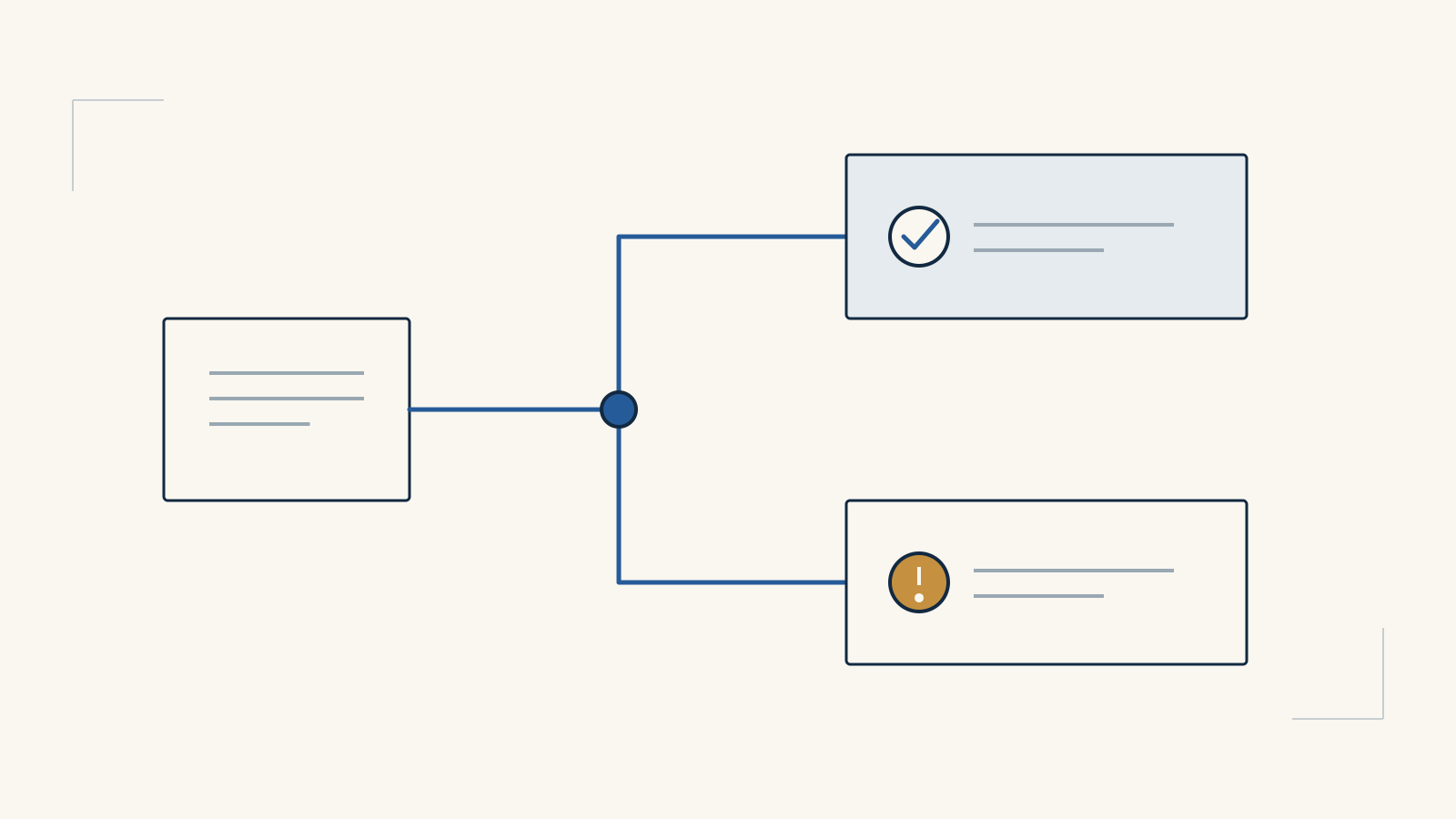
One option waits for the scheduling system before returning to the patient. This can support an immediate answer when the downstream system provides one, but makes the patient experience depend on its availability and response behavior.
Another option accepts the request locally and passes it onward for processing. This can preserve the request during a downstream interruption, but introduces pending states, duplicate handling, recovery responsibilities, and a need to explain status accurately.
Neither option is universally better. Compare them against the same constraints: the meaning of acceptance, the availability expectation, the information boundary, the recovery process, and the scheduling team's ability to operate it.
Make the selected option carry its conditions
Suppose the team chooses to accept requests for later processing. A compact decision record would include:
- Observation: the scheduling interface can be unavailable during maintenance, according to its owner and operating documentation.
- Constraint: a patient must not receive a booking confirmation until the authorized scheduling process confirms the appointment.
- Choice: accept the request, show a pending status, and send it for downstream processing.
- Rationale: preserve the request during interruption while keeping submission separate from booking.
- Required behavior: correlate retries, prevent duplicate processing, and expose failed requests to the responsible team.
- Review condition: confirm information handling and the recovery procedure before release authorization.
This record gives engineering more than a preferred integration pattern. It explains the behavior the design must preserve and the conditions that still require review.
Review a failure, not just the diagram
Ask the team to walk through an interruption after the request is accepted but before scheduling confirms receipt. Then repeat the request. Who can tell whether it was processed? What does the patient see? Which operator can resolve an ambiguous result?
Next, change one assumption: the scheduling interface cannot accept the proposed request identifier. The architecture choice may still be viable, but the duplicate-handling design needs more work. The trace should make that dependency visible rather than letting the change disappear inside an implementation ticket.
Archangel connects requirements, architecture choices, constraints, reviewer actions, and delivery work around decisions like these. It can support the preparation and review of the package; the relevant owners still determine whether the design and its controls satisfy their requirements.
The useful result is an integration the team can explain: what the patient is being told, where the information goes, what happens when processing fails, and who is authorized to resolve it. For the structure behind the worked example, read what to capture in a Decision Trace.
Continue reading
All resources
Architecture & Delivery
What an Engineering Handoff Should Contain
A practical guide to the requirements, architecture, decisions, evidence, and open conditions that make a handoff useful to engineering.
Decision Trace & Evidence
Decision Trace: What to Record Before the Reasoning Disappears
Walk through an architecture choice and the observations, constraints, options, rationale, and review that make it understandable later.
Architecture & Delivery
How to Evaluate Architecture Governance on One Real Initiative
Choose a bounded initiative, inspect its decisions and outputs, introduce a change, and judge whether the handoff helps your team move forward.
From reading to review
Bring one real initiative.
See how Archangel connects requirements, architecture decisions, and engineering work.